WA

Written & reviewed by WhatAreAllergies Editorial Team

Editorial Review

Health Editors & Medical Writers · Allergy, Immunology & Clinical Health Content

WhatAreAllergies.com

Updated May 2026·Annual review cycle

Our editorial process: All content on WhatAreAllergies.com is written and reviewed by our editorial team following published guidelines from ACAAI, AAAAI, WAO, and ARIA. Content is updated annually or when major guidelines change. This content is educational only — not a substitute for professional medical advice. We do not accept advertising influence on editorial content. Read our editorial policy →

Quick Answer

Dust mite allergy causes year-round rhinitis, asthma, and eczema worsening — with symptoms often worst in the morning and after disturbing bedding or upholstered furniture. The allergens are fecal pellets and body fragments of microscopic Dermatophagoides mites. Allergen-impermeable bedding covers, hot water laundering, humidity control, and HEPA vacuuming are the most effective environmental controls.
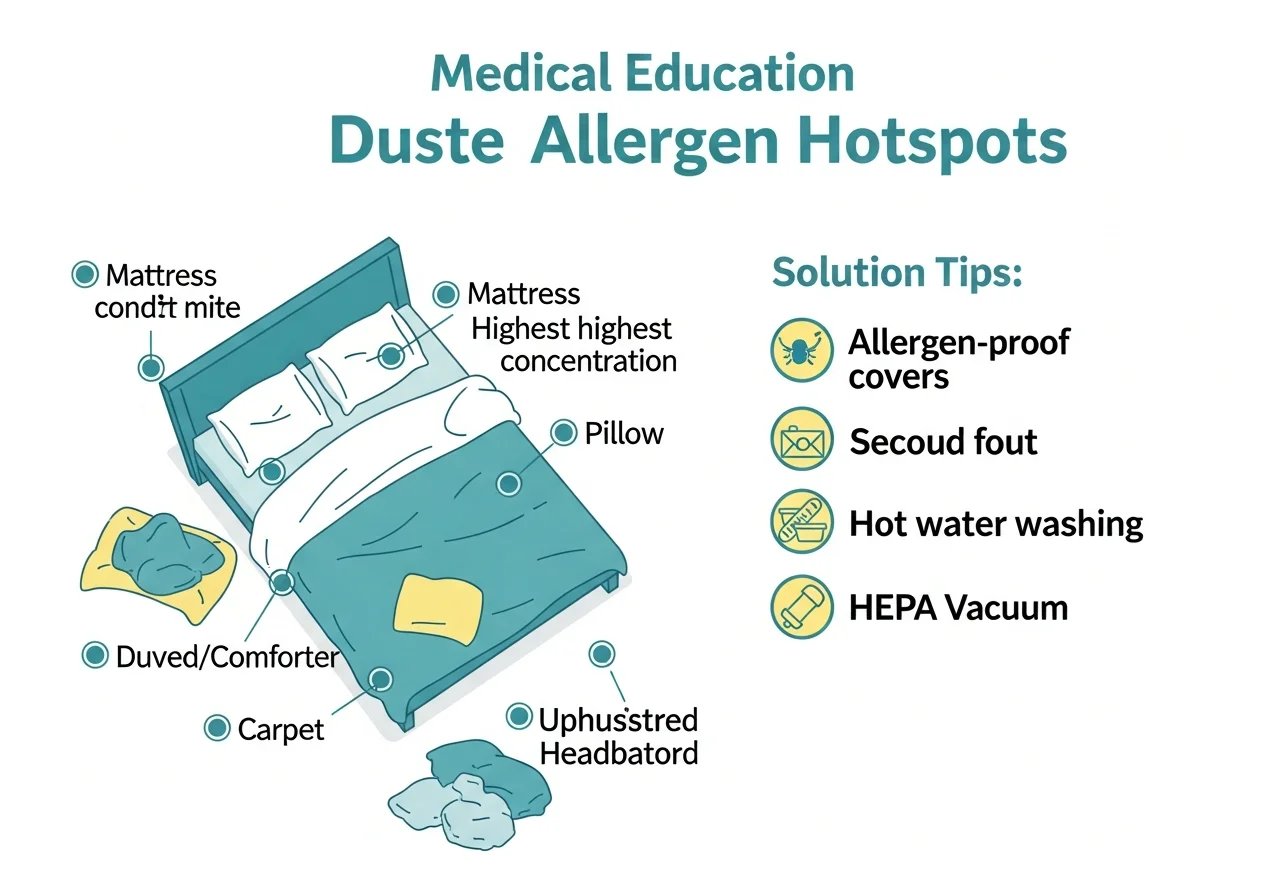
Bedroom diagram showing dust mite allergen hotspots with labeled call-out circles: mattress (highest mite concentration), pillow, duvet, carpet, stuffed animals, and upholstered headboard — with allergen-reduction tips sidebar
Dust mite allergen hotspots in the bedroom — mattress and pillows harbor the highest concentrations | WhatAreAllergies.com

Dust Mite Allergy Symptom Checklist

Year-round sneezing and runny nose
Nasal congestion worst in the morning
Itchy, watery eyes
Post-nasal drip and chronic throat clearing
Coughing, especially at night
Wheezing or chest tightness (if asthmatic)
Eczema flares on skin
Symptoms worse in bedroom and during bed-making
Symptoms better when away from home for >48 hours
No seasonal pattern — present year-round

Why Dust Mite Allergens Are So Pervasive

House dust mites are one of the most clinically significant aeroallergen sources worldwide, sensitizing an estimated 1 billion people globally. Their primary allergens — Der p 1 and Der p 2 (D. pteronyssinus) and Der f 1 and Der f 2 (D. farinae) — are proteases and lipid-binding proteins that directly cleave tight junctions in airway and conjunctival epithelium, disrupting the mucosal barrier and facilitating allergen penetration. This barrier disruption explains why dust mite allergy is so strongly linked to both rhinitis and eczema. Understanding how allergens trigger the immune system explains why sensitized individuals react even to low allergen exposures.

Dust Mite vs Seasonal Allergy: How to Tell Them Apart

The most distinguishing feature of dust mite allergy is its year-round, perennial pattern without seasonal variation. Pollen allergies improve or resolve when pollen season ends. Dust mite allergy persists throughout the year, is worse indoors (especially the bedroom), often worst in the morning upon waking, and improves when the patient spends extended time away from home. Humidity strongly influences symptom severity — dry winter air reduces mite populations but increases nasal mucosal dryness; humid summer conditions increase mite growth and allergen production.

Formal allergy testing with skin prick testing or specific IgE blood testing to dust mite extracts definitively distinguishes mite allergy from other causes of perennial rhinitis including pet allergy, mold allergy, and non-allergic (vasomotor) rhinitis.

When Dust Mite Allergy Symptoms Are Serious

  • Asthma exacerbations: Dust mites are the single most common indoor asthma trigger — inadequate dust mite control in asthmatic households is strongly associated with increased hospitalizations and emergency visits
  • Severe eczema: Dust mite sensitization is a major contributor to difficult-to-control atopic dermatitis — barrier disruption by Der p 1 protease directly worsens skin disease
  • Chronic sinusitis: Persistent mite-driven nasal inflammation predisposes to recurrent sinus infections requiring ENT evaluation
  • Sleep disruption: Nighttime nasal congestion from dust mite allergy can contribute to sleep-disordered breathing, including obstructive sleep apnea worsening

Environmental Control Strategies

InterventionEffectivenessNotes
Allergen-impermeable mattress/pillow coversHighMost evidence-based single intervention; reduces allergen 50–80%
Weekly hot wash of bedding (≥60°C/140°F)HighKills mites and removes allergen from linen
Indoor humidity below 50%HighMites cannot survive below 50% relative humidity
HEPA vacuum cleanerModerateReduces surface allergen; prevents aerosolizing during vacuuming
Remove bedroom carpetsModerate-HighCarpet holds 100x more allergen than hard flooring
Wash stuffed toys weeklyModerateChildren's toys are significant reservoirs
Air filtration (HEPA)Low-ModerateCaptures airborne particles; small adjunctive benefit

Treatment Overview

Environmental controls form the foundation of dust mite allergy management but are rarely sufficient alone for significantly sensitized patients. Medical treatment follows the same framework as other aeroallergen allergies: antihistamines for symptom control, intranasal corticosteroid sprays for chronic nasal inflammation, and inhaled corticosteroids for asthma. Allergen immunotherapy for dust mites has strong evidence from randomized controlled trials — both subcutaneous (allergy shots) and sublingual (drops/tablets) approaches are clinically validated for D. pteronyssinus and D. farinae. See our complete treatment guide for all options, and our severe allergies overview for cases where symptoms significantly impact quality of life.

Frequently Asked Questions

What are the symptoms of dust mite allergy?
Dust mite allergy causes perennial (year-round) allergic rhinitis: sneezing, runny nose, nasal congestion, post-nasal drip, and itchy eyes. Symptoms are often worse in the morning (mites concentrate in bedding) and during vacuuming or bed-making. In asthmatics, dust mite exposure is a major trigger for wheezing and chest tightness. Dust mite sensitivity also contributes to atopic dermatitis (eczema) flares.
Where do dust mites live?
House dust mites (Dermatophagoides pteronyssinus and D. farinae) thrive in warm (20–25°C), humid (>50% relative humidity) environments. They are most concentrated in mattresses, pillows, and bedding where humans spend 6–8 hours nightly providing shed skin scales as food. Secondary hotspots include upholstered furniture, carpets, and stuffed toys.
Can I see dust mites?
No. House dust mites are approximately 0.3 mm long — invisible to the naked eye. The allergenic proteins are not in the mite's body itself but in their fecal pellets and body fragments, which are so tiny they remain airborne and become inhaled easily. Standard vacuuming without HEPA filters can actually increase airborne allergen levels temporarily.
How do I reduce dust mite allergen in my home?
The most effective dust mite reduction measures are: allergen-impermeable covers for mattress, box spring, and pillows (reduces allergen by 50–80%), washing bedding weekly in hot water (≥60°C/140°F kills mites and removes allergen), reducing indoor humidity below 50%, HEPA vacuum cleaning, removing bedroom carpets if possible, and washing stuffed toys weekly.
Is dust mite allergy the same as dust allergy?
No. Most people who think they have a 'dust allergy' are actually reacting to proteins from house dust mites, cockroaches, or mold that are present in household dust. True allergy to dust particles themselves is not an established diagnosis. Distinguishing between dust mite allergy, cockroach allergy, and mold allergy requires formal allergy skin testing or specific IgE blood testing.

About the Medical Team

WA
Medical Review

WhatAreAllergies Editorial Team,

Health Editors & Medical Writers

Allergy, Immunology & Clinical Health Content

WhatAreAllergies.com
WA
Written by

WhatAreAllergies Editorial Team,

Health Content Editor

Clinical Allergy & Immunology Content

WhatAreAllergies.com

Content is written by our editorial team following current clinical guidelines from ACAAI, AAAAI, and WAO. Educational only — always consult a qualified healthcare provider for medical advice. View editorial policy →

Medical References & Citations

  1. 1
    guideline2006

    Sampson HA, et al. "Second symposium on the definition and management of anaphylaxis: Summary report" — Journal of Allergy and Clinical Immunology.

    View source
  2. 2
    database2025

    American College of Allergy, Asthma & Immunology (ACAAI) "Allergy Facts and Figures" — ACAAI Clinical Resources.

    View source
  3. 3
    review2025

    World Allergy Organization (WAO) "White Book on Allergy — 2025 Update" — World Allergy Organization.

    View source
  4. 4
    guideline2024

    National Institute of Allergy and Infectious Diseases (NIAID) "Clinical Guidelines for the Diagnosis and Management of Food Allergy" — National Institutes of Health.

    View source
  5. 5
    guideline2024

    Muraro A, et al. "EAACI food allergy and anaphylaxis guidelines: Diagnosis and management of food allergy" — Allergy — European Journal of Allergy and Clinical Immunology.

This content reflects clinical guidelines current as of the last review date shown above. Always consult a qualified healthcare provider for personalized medical advice.